


What Is a Firewall &
Why Does Your Business Need One?
You lock your office at the end of the day. You control who has keys, who can access certain areas, and who can get near sensitive business information.
Your computer network needs similar protection.
That is where a firewall comes in.
Most business owners have heard the word “firewall”, and you may already have one protecting your network without giving it much thought. But what exactly does a firewall do? What is it protecting you from? And is the basic firewall built into your internet router enough for a modern business?
Let’s unpack it without getting buried in technical jargon.
What Is a Firewall?
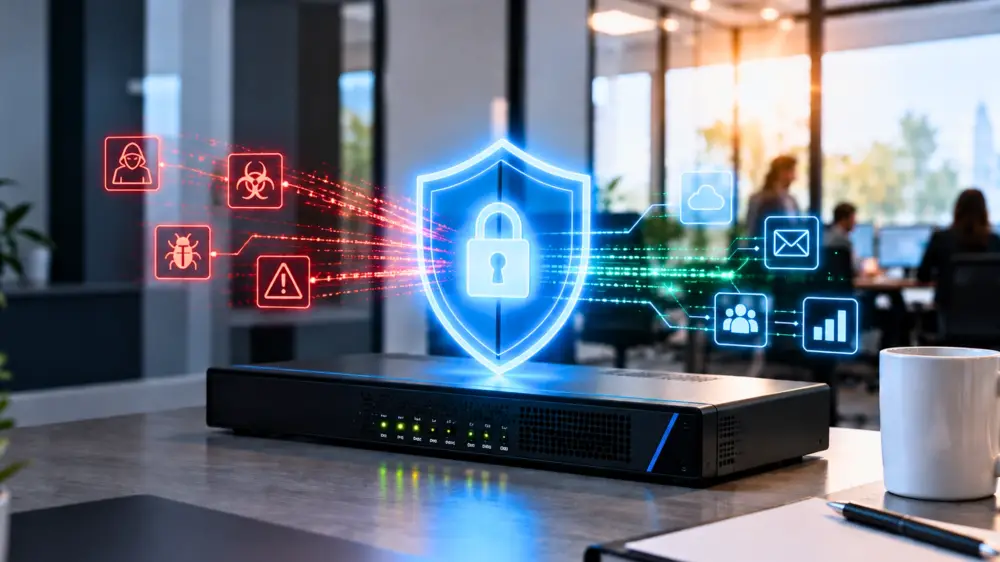
A firewall is a security system that monitors and controls traffic moving into and out of a computer or network.
Think of it as a security checkpoint between your business network and the outside world.
Every day, information moves between your devices and the internet. Employees browse websites, send emails, access cloud applications, download files, join online meetings and use business systems.
At the same time, systems outside your business may try to communicate with devices on your network.
A firewall checks this traffic against a set of security rules and decides what to allow through and what to block.
In simple terms:
Your firewall helps decide who and what gets through the digital front door.
How Does a Firewall Work?
Information travelling across a network is broken into small pieces of data called packets.
A firewall examines network traffic and applies rules to decide whether to allow it.
Depending on the type of firewall, it may look at things such as where the traffic is coming from, where it is going, the IP address involved, the network port being used and which application is requesting the connection.
If the traffic meets the network’s security rules, it is allowed through.
If it does not, the firewall can block it.
Modern firewalls can do much more than allow or deny connections. They can inspect network traffic in greater detail, identify applications, detect suspicious behaviour and give businesses far more visibility over what is happening across their networks.
A Simple Business Example
Imagine a business with 20 employees.
The company has laptops, smartphones, VoIP phones, Wi-Fi, printers, cloud accounting, Microsoft 365, a server and guest Wi-Fi for visitors.
Should someone connected to the guest Wi-Fi automatically have access to the company’s server?
Probably not.
Should every unknown computer on the internet be allowed to connect directly to an employee’s computer?
Definitely not.
And if a compromised laptop suddenly starts trying to communicate with a suspicious server somewhere on the internet, shouldn’t something notice?
This is where a firewall becomes important.
Instead of treating every connection as trusted, the firewall helps control which users, devices, applications and services are allowed to communicate.
It becomes one layer in a broader business network protection strategy.
What Does a Firewall Protect Your Business From?
A firewall helps reduce unnecessary and potentially dangerous access to your network.
Unauthorised Access
One of a firewall’s most basic functions is preventing unwanted connections from reaching devices and services on your network.
Internet-connected systems can potentially be discovered by automated systems searching the internet for vulnerable devices. A properly configured firewall helps control what those outside systems can reach.
Suspicious Network Traffic
Modern business firewalls can identify certain patterns of suspicious or malicious network activity and block traffic before it reaches systems inside your organisation.
This adds an important layer of protection against network-based attacks.
Unwanted Outgoing Connections
Firewalls don’t only monitor what is trying to get into your business.
They can also monitor traffic leaving your network.
If a compromised device or malicious application tries to communicate with an unknown external system, firewall security features may help identify or block that communication.
Unwanted Websites and Applications
Business firewalls can also control the websites and applications employees can access.
This can help with security, productivity, compliance, and bandwidth management.
Unnecessary Exposure
Every unnecessary connection or service exposed to the internet can potentially create another opportunity for attack.
A well-configured firewall helps reduce this exposure by allowing only the network traffic your business actually needs.
What Are the Different Types of Firewalls?
Not every firewall works in the same way.
In fact, you may already be using more than one type without realising it.
Software Firewalls
A software firewall runs on an individual computer or device.
Windows, for example, includes its own firewall functionality to help control incoming and outgoing connections on that particular computer.
This protection remains with the device even when it leaves the office and connects to another network.
Hardware or Network Firewalls
A network firewall sits between networks.
In a typical business environment, it is positioned between the company’s internal network and its internet connection.
Instead of protecting only one computer, it can control traffic for multiple devices across the organisation.
Ativo provides dedicated business firewall solutions for small office, business and corporate environments.
Cloud or Virtual Firewalls
Not every business system lives inside the office anymore.
Companies increasingly use cloud infrastructure, hosted systems and remote working environments.
Virtual and cloud firewalls can provide similar network-security controls in these environments.
The right approach depends on how your organisation’s network, cloud systems, users and remote access are structured
Doesn’t My Router Already Have a Firewall?
Probably.
Many internet routers include basic firewall functionality.
That is useful, but there is a big difference between having a firewall and having firewall protection properly designed for a business environment.
Consider what even a relatively small business may use today:
Remote workers, Microsoft 365, cloud applications, VoIP, guest Wi-Fi, online accounting software, servers, multiple employee devices and VPN connections.
A basic internet router may not provide the visibility, management or security features that a growing business requires.
Business-grade firewalls can provide capabilities such as intrusion prevention, web filtering, application control, VPN connectivity, reporting and bandwidth management.
So the better question isn’t simply:
“Do we have a firewall?”
It is:
“Is our firewall suitable for the way our business works today?”
What Is a Next-Generation Firewall?
Traditional firewalls primarily controlled connections using rules based on information such as IP addresses and network ports.
Business networks and cyber threats have become much more complex.
A Next-Generation Firewall, often shortened to NGFW, combines traditional firewall functionality with additional security and network-management capabilities.
These may include:
Intrusion Prevention
An Intrusion Prevention System, or IPS, monitors network traffic for known suspicious or malicious behaviour and can automatically block certain threats.
Deep Packet Inspection
Instead of only looking at basic connection information, deep packet inspection allows the firewall to analyse network traffic in more detail.
Web Filtering
Businesses can control access to websites or categories of websites that may present a security, compliance or productivity risk.
Application Control
Modern firewalls can help businesses understand and control the applications using their internet connection.
VPN Connectivity
A Virtual Private Network can provide employees or branch offices with secure remote access to approved business resources.
Bandwidth Management
Not all internet traffic is equally important.
Your VoIP calls, cloud accounting system and other critical business applications may need priority over non-essential internet traffic.
A firewall can help manage bandwidth so important business services receive the resources they need.
Security Reporting
Business firewalls can also provide useful information about network activity, blocked threats, internet usage and connections.
At Ativo ICT, we use Sophos Firewall products for our business and corporate clients. These next-generation firewalls offer security features including intrusion prevention, secure VPN connectivity, web filtering, data prioritisation and application-layer protection.
Firewall vs Antivirus: What’s the Difference?
A firewall and antivirus or endpoint security are not the same thing.
A firewall primarily controls network communications.
Antivirus and endpoint security focus more closely on what is happening on an individual computer or device, such as malicious files, malware or suspicious software activity.
Think of your office again.
The firewall helps guard the entrances.
Endpoint security helps protect what happens inside individual offices.
You want both.
Good cybersecurity works in layers, with different security measures performing different jobs rather than relying on one product to stop everything.
What Can’t a Firewall Protect You From?
A firewall is important, but it isn’t a magic shield around your business.
Imagine an employee receives a convincing phishing email, clicks the link and enters their Microsoft 365 username and password into a fake login page.
A firewall cannot simply undo the fact that the employee has handed their login details to a criminal.
That is why businesses also need controls such as email security protection, endpoint protection, multifactor authentication, strong access controls, software updates, secure backups and staff awareness.
The same layered approach is important when protecting your business against ransomware.
Firewall protection is one layer.
Email security is another.
Endpoint protection is another.
Backup and data protection add further layers.
The goal is that if one security control doesn’t stop a threat, another may.
A Firewall Is Only as Good as Its Configuration
This is one of the most important things businesses need to understand about firewalls.
Buying an expensive firewall does not automatically make your network secure.
It needs to be correctly configured and properly managed.
Firewall rules must match how the business operates. Security features need to be enabled appropriately. Software and firmware must stay current. Remove unnecessary access, and pay attention to alerts and reports.
Your network also changes over time.
Employees join and leave.
New applications are introduced.
Cloud systems are added.
Remote-working requirements change.
New devices connect to the network.
A firewall configuration that suited the business several years ago may not match the way the organisation works today.
Good cybersecurity isn’t simply about owning the right technology. It’s about configuring and managing that technology correctly.
Does My South African Business Need a Firewall?
If your organisation connects to the internet, uses cloud applications, handles customer or business information or has multiple employees and devices, firewall protection should form part of your cybersecurity strategy.
That doesn’t mean every business needs the same firewall.
A five-person accounting firm is unlikely to have the same network requirements as a company with 150 employees, multiple offices and public-facing servers.
The right solution depends on factors such as the number of users and devices, internet connection, cloud applications, remote workers, VPN requirements, servers, guest networks, sensitive data, reporting requirements and future growth.
That is why choosing a firewall should start with understanding your business environment, not simply selecting a device from a catalogue.
How Ativo ICT Can Help Protect Your Business Network
Your firewall sits at an important point in your business network.
It shouldn’t be treated as something you plug in once and then forget.
At Ativo ICT, we help businesses assess their network requirements, choose the right firewall technology, and configure it to match how the organisation actually operates.
We use Sophos Firewall products for business and corporate environments and combine firewall security with the broader cybersecurity and network solutions each business requires.
More importantly, we look at the firewall as one part of the complete IT environment.
Because protecting your organisation isn’t only about one box sitting next to the router.
It’s about making sure your network, devices, users, cloud services, email and security controls work together.
If you are unsure whether your current firewall still suits your business, speak to Ativo ICT about your network and cybersecurity requirements, or learn more about our business IT support services.
Call Ativo ICT on 011 051 9229 or email [email protected].
________________________________________